Bonus: Compliance Testing
Purpose
The compliance_test program is an automated end-to-end test suite that exercises all three security phases in a single run. It was designed for three audiences:
- Graders: produces a structured
PASS / FAILreport with student identity - Developers: catches regressions after kernel changes
- Auditors: maps each test to a security requirement
How Tests Work
Each test follows this pattern:
static void assert_pass(const char *name, int cond) {
  passes += cond;
  fails  += !cond;
  printf("[%s] %s\n", cond ? "PASS" : "FAIL", name);
}

static void assert_fail(const char *name, int cond) {
  assert_pass(name, !cond);   // we expect the operation to be denied
}
assert_fail is used for "this must be rejected" tests. If the kernel incorrectly allows the operation, the test reports FAIL.
The 18 Tests
Phase 1: Authentication (T01–T06)
| ID | Test name | Description |
|---|---|---|
| T01 | valid_admin_login | login("admin","admin123") → 0 |
| T02 | valid_patient_login | login("patient1","patient123") → 0 |
| T03 | wrong_password_rejected | login("admin","wrong") → -1 |
| T04 | whoami_returns_username | whoami(buf,16) returns "patient1" |
| T05 | useradd_by_patient_denied | useradd(...) as patient → -1 |
| T06 | userdel_by_patient_denied | userdel(...) as patient → -1 |
Phase 2: File Permissions (T07–T12)
| ID | Test name | Description |
|---|---|---|
| T07 | patient_cannot_open_config | open("/device/config", O_RDONLY) as patient → -1 |
| T08 | patient_can_read_records | open("/patient/records", O_RDONLY) as patient → fd ≥ 0 |
| T09 | patient_cannot_write_records | open("/patient/records", O_WRONLY) as patient → -1 |
| T10 | doctor_can_write_dosage | open("/dosage/insulin.log", O_WRONLY) as doctor → fd ≥ 0 |
| T11 | doctor_cannot_read_config | open("/device/config", O_RDONLY) as doctor → -1 |
| T12 | admin_can_open_all | Admin opens /device/config, /audit/syscall.log → success |
Phase 3: Audit Log (T13–T17)
| ID | Test name | Description |
|---|---|---|
| T13 | patient_cannot_read_audit | audit_read(buf, n) as patient → -1 |
| T14 | admin_can_read_audit | audit_read(buf, n) as admin → entries returned |
| T15 | audit_records_denied_open | T07 denial appears in audit ring |
| T16 | audit_records_successful_write | T10 success appears in audit ring |
| T17 | end_to_end_attack_detection | Login→deny→audit confirms the attacker attempt |
Integration (T18)
| ID | Test name | Description |
|---|---|---|
| T18 | all_phases_active | Re-verify auth + permission + audit all active simultaneously |
T17 End-to-End Narrative
T17 is the flagship test. It simulates a realistic attack scenario:
- Authenticate as patient (
login("patient1","patient123")) - Attempt unauthorized access (
open("/device/config", O_RDONLY)→ denied) - Switch to admin (
login("admin","admin123")) - Read audit ring (
audit_read(buf, sizeof buf)) - Search ring for the denial: find an entry with
syscall_no == SYS_open,uid == <patient_uid>,result == -1 - Assert found: if the entry exists, T17
PASS
This proves all three phases interlock: Phase 1 provided the UID, Phase 2 denied the access and returned -1, Phase 3 recorded the result.
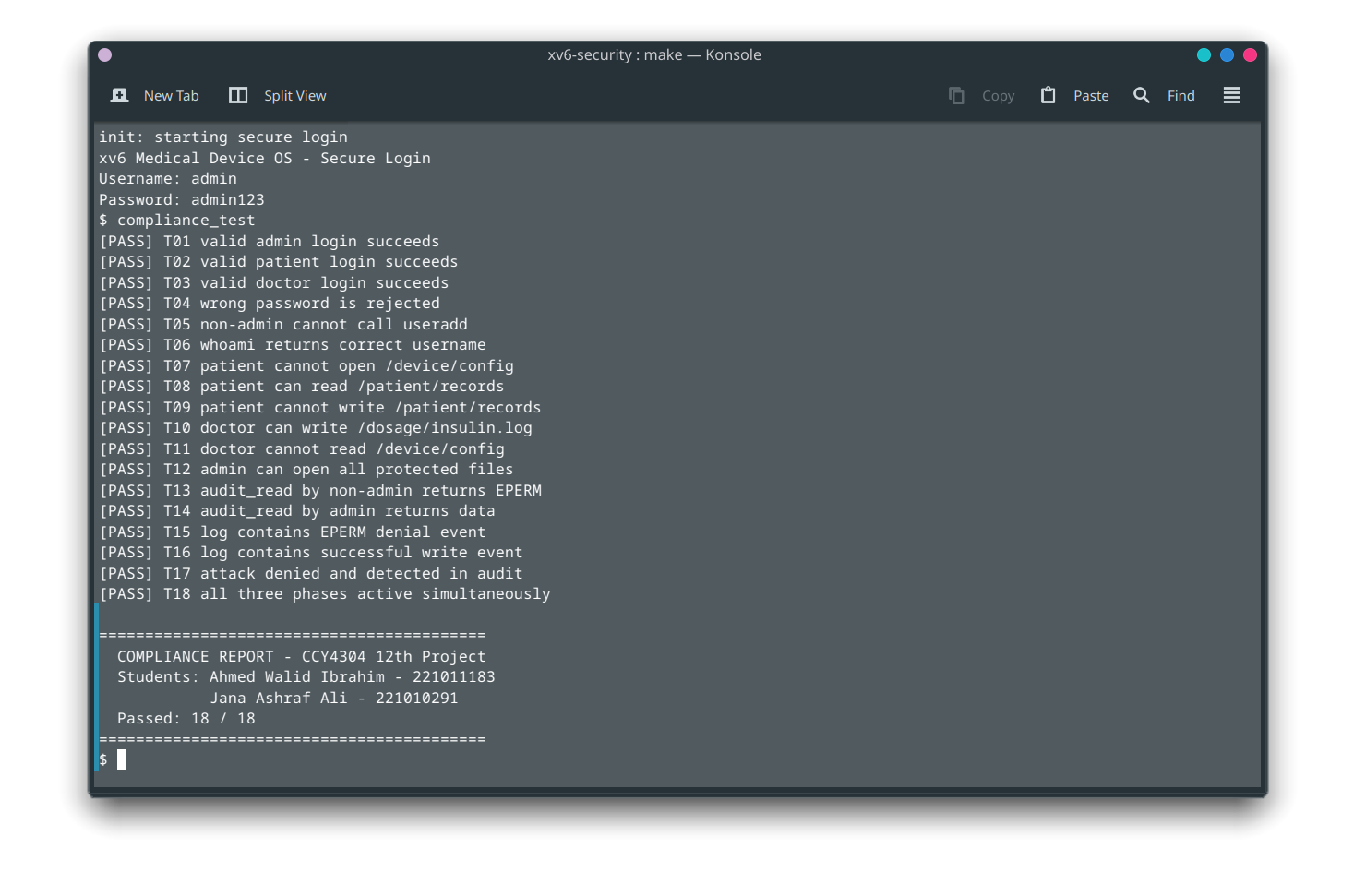
Running the Tests
# Build and boot
cd xv6-security
make clean && make
make qemu

# At the login prompt
login: admin
password: admin123

# Run the suite
$ compliance_test
Known Implementation Details
DIRSIZ 16: The filenamecompliance_testis 16 characters, requiringDIRSIZincreased from 14 to 16 inkernel/fs.h.mkfs.cpadding was updated accordingly.- Audit ring ordering: T15/T16 search backward from the newest entry. The ring may contain stale entries from earlier test phases; the search uses
uid+resultas a compound key. - No libc: xv6 user programs have no C standard library. The test uses
memcmpfor string comparison and manualitoafor number formatting.