Phase 3: Audit Log
Motivation
Authentication and file permissions control what can happen. But after a security incident, investigators need to know what did happen, when, and who triggered it. Without an audit trail:
- A clinician could claim they never wrote a dosage file.
- An intrusion could go undetected indefinitely.
- Regulatory review would have no evidence to examine.
Phase 3 adds a kernel-resident audit ring buffer that records every security-relevant syscall event.
Original xv6 vs Phase 3 Code Delta
Stock xv6 does not keep a security audit trail of syscall outcomes. This phase adds a dedicated audit subsystem and an admin-only read interface.
| Component | Stock xv6-riscv | Modified xv6-security |
|---|---|---|
| Syscall event logging | No persistent syscall audit records | audit_log(syscall_no, result) called on every syscall return |
| Kernel storage | None | Fixed-size ring buffer (AUDIT_BUF_SIZE = 256) with spinlock protection |
| Audit record fields | N/A | pid, uid, syscall_no, result, tick, comm |
| User access path | N/A | sys_audit_read + audit_dump user tool |
| Access control | N/A | Audit read restricted to uid == 0 |
Files touched for this phase: kernel/audit.h, kernel/audit.c, kernel/syscall.c, kernel/sysfile.c, kernel/syscall.h, and user/audit_dump.c.
Design: Ring Buffer
A ring buffer is the right structure for kernel-space audit logging because:
- Bounded memory: No dynamic allocation in syscall paths.
- O(1) write: Head and tail pointer arithmetic only.
- Graceful overwrite: Oldest events are silently dropped when full, keeping the system live.
Ring buffer: 256 slots, each is struct audit_entry

head ───▶ [entry 0] [entry 1] ... [entry N] ──▶ tail wraps
           oldest                              newest
The buffer is protected by a spinlock_t so concurrent harts cannot corrupt the shared head/tail pointers.
struct audit_entry
/* kernel/audit.h */
struct audit_entry {
  int  pid;           // process ID of caller
  int  uid;           // user ID of caller (from proc->uid)
  int  syscall_no;    // SYS_open, SYS_write, SYS_login, ...
  int  result;        // return value of the syscall
  uint tick;          // kernel tick count (for ordering)
  char comm[16];      // first 15 chars of p->name
};

#define AUDIT_BUF_SIZE 256
audit_log() Implementation
Called at the end of every syscall handler (before returning to user space):
// kernel/audit.c
void audit_log(int syscall_no, int result) {
  struct proc *p = myproc();

  acquire(&audit_lock);
  struct audit_entry *e = &ring[head];
  e->pid        = p->pid;
  e->uid        = p->uid;
  e->syscall_no = syscall_no;
  e->result     = result;
  e->tick       = ticks;
  memmove(e->comm, p->name, sizeof e->comm);
  head = (head + 1) % AUDIT_BUF_SIZE;
  if (count < AUDIT_BUF_SIZE)
    count++;
  else
    tail = (tail + 1) % AUDIT_BUF_SIZE;
  release(&audit_lock);
}
In this repository, the hook is placed in kernel/syscall.c after syscall dispatch and before returning to user mode, so both successful and denied operations are captured with the same mechanism.
Trap-Level Audit Printing
kernel/trap.c uses usertrap() to intercept every syscall at the ECALL boundary. Security events are recorded into the ring buffer via audit_log() from the appropriate syscall handlers rather than printed directly from the trap handler. Printing from the trap handler would cause recursive spam, because printf itself invokes write syscalls, one character at a time. Each printed character would log another trap, which would print again.
The ring buffer approach is the correct mechanism: use audit_dump to inspect the captured entries after a session.
Relative to stock xv6, this separates auditing from console output and provides machine-readable records for compliance tests.
audit_read: Admin-Only Access
// kernel/sysfile.c
int sys_audit_read(void) {
  struct proc *p = myproc();
  if (p->uid != 0)              // not admin
    return -1;                  // EPERM

  // copy ring entries to user buffer ...
}
Non-admin callers receive -1 immediately. The kernel does not reveal even the buffer size to unprivileged processes.
This is intentionally stricter than basic teaching-kernel behavior: audit observability is itself treated as privileged data.
audit_dump Tool
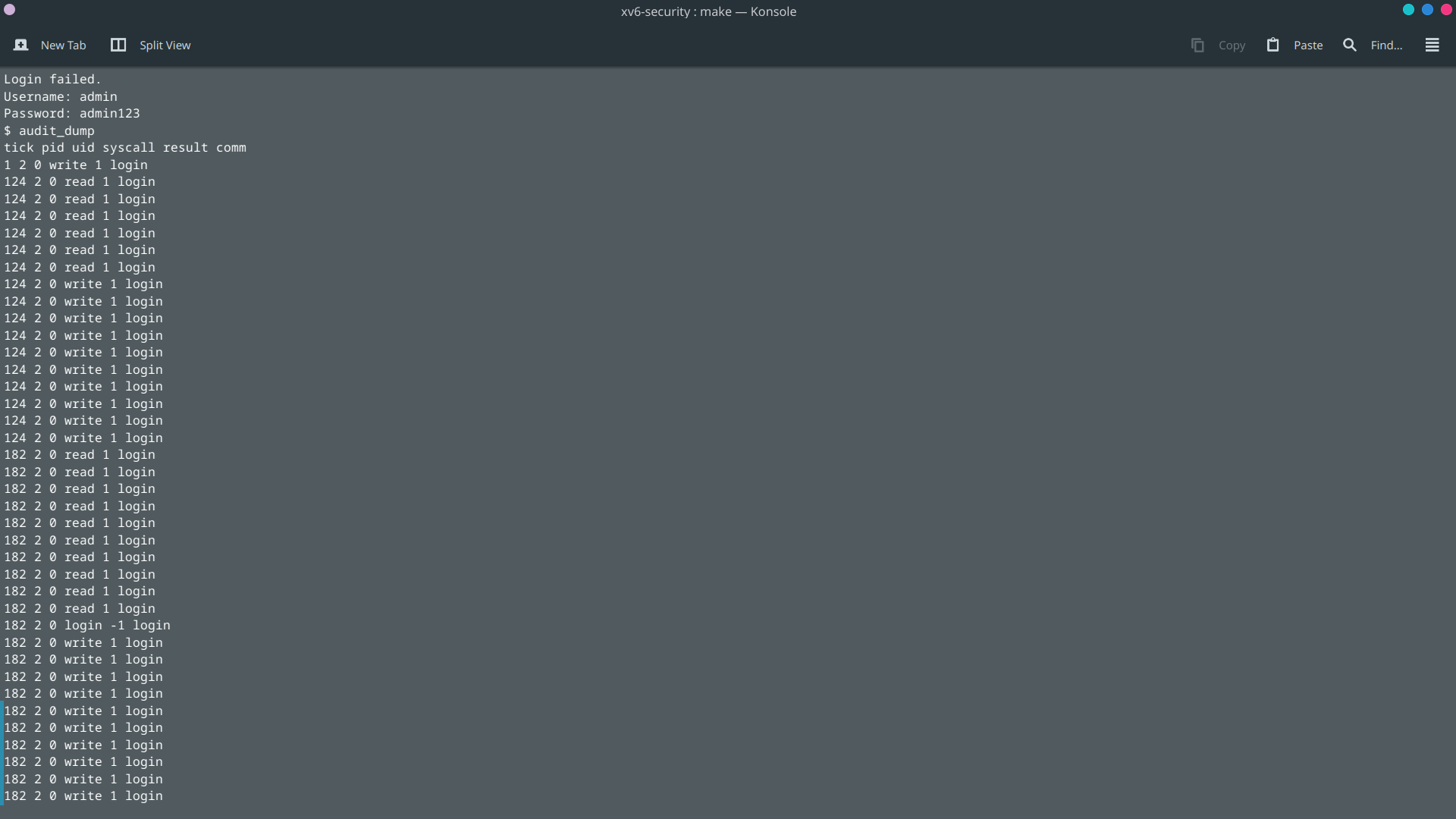
Inside xv6, the admin can run:
$ audit_dump
tick pid uid syscall result comm
12 3 0 login 0 login
45 4 1 open 3 sh
67 4 1 open -1 compliance
89 4 0 audit_read 0 compliance
The columns are tick pid uid syscall result comm. The syscall name has no SYS_ prefix. A -1 result on open is a denied access. In the sample above, uid 1 (patient) tried to open a file and got -1. That is exactly the kind of evidence Phase 2 and Phase 3 together provide.
Compliance Coverage
| Test | What it checks |
|---|---|
| T13 | audit_read by non-admin returns -EPERM |
| T14 | audit_read by admin succeeds and returns entries |
| T15 | A denied open (from T07) appears in the audit log |
| T16 | A successful write (from T10) appears in the audit log |
| T17 | Full end-to-end: login → denied open → audit confirms the denial |
Security Notes
- Audit records are in-kernel only. A patient process cannot reach the buffer.
- The ring is volatile. It does not survive a reboot. A production system would flush to persistent storage.
- Audit should be paired with access control, not treated as a substitute for it. Logging a denial is useful; preventing the action is essential.