Phase 2: File Permissions
Motivation
After Phase 1 establishes who the user is, Phase 2 answers what they are allowed to touch. Without file permissions, a logged-in patient can open /device/config, overwrite /dosage/insulin.log, or read the audit log: defeating the entire point of authentication.
Phase 2 adds Unix-style DAC (Discretionary Access Control) to every inode.
Original xv6 vs Phase 2 Code Delta
Stock xv6 has inode ownership fields in memory but not full Unix-style per-inode permission enforcement across all relevant syscall paths. This phase makes permissions first-class and enforced end-to-end.
| Component | Stock xv6-riscv | Modified xv6-security |
|---|---|---|
| On-disk inode metadata | No mode/uid/gid persisted in this project baseline | Added mode, uid, gid to struct dinode |
| In-memory inode/stat propagation | Limited metadata for DAC decisions | mode, uid, gid loaded/stored via ilock, iupdate, stati |
| Permission helper | None | perm_check(ip, access) in kernel/perms.c |
| Enforcement points | Mostly open-time semantics | Explicit checks in sys_open, fileread, filewrite, sys_exec |
| File ownership initialization | Generic file creation defaults | Ownership defaults set from caller identity during inode allocation |
Files touched for this phase: kernel/fs.h, kernel/file.h, kernel/stat.h, kernel/fs.c, kernel/file.c, kernel/sysfile.c, kernel/perms.h, kernel/perms.c, mkfs/mkfs.c, plus user tools user/chmod.c and user/chown.c.
The Permission Bit Model
Unix permission bits pack into a 16-bit mode word:
  15–12     11–9      8–6       5–3       2–0
  filetype  (unused)  owner     group     other
              rwx       rwx       rwx
Each three-bit group:
| Bit position | Meaning |
|---|---|
r (bit 2) | Read access |
w (bit 1) | Write access |
x (bit 0) | Execute access |
Example: 0644 = rw-r--r--:
- Owner: read + write
- Group: read only
- Other: read only
What Changed in struct dinode
/* kernel/fs.h: new fields on the on-disk inode */
struct dinode {
  short  type;    // existing: T_FILE, T_DIR, T_DEVICE
  ushort mode;    // NEW: octal permission bits, e.g. 0644
  ushort uid;     // NEW: owner user ID
  ushort gid;     // NEW: owner group ID
  // ... rest unchanged ...
};
The in-memory struct inode mirrors these fields. ialloc, iupdate, ilock, and stati all read and write the new fields.
This is the key difference from original xv6 behavior in this codebase: permission decisions are now based on persistent inode metadata rather than ad hoc assumptions in user space.
Medical Files and Their Permissions
mkfs/mkfs.c creates these files at image build time:
| Path | Mode | Owner | Accessible by |
|---|---|---|---|
/patient/records | 0400 | uid=1, gid=1 | Patient reads, admin override |
/dosage/insulin.log | 0640 | uid=2, gid=1 | Doctor (owner) writes, patient (group) reads, admin override |
/device/config | 0600 | uid=0, gid=0 | Admin only |
/audit/syscall.log | 0400 | uid=0, gid=0 | Admin read-only |
The insulin log is the one file two roles share. The doctor owns it and writes new doses. The patient is put in the file's group (gid=1) with read-only group bits, so they can see their dose history but never change it. Nobody else gets any access.
perm_check() Flowchart
Walkthrough: a Patient Opens /device/config
Say the patient is logged in (uid=1, gid=1) and runs cat /device/config. The file is owned by admin (uid=0, gid=0) with mode 0600. Here is what the kernel does, step by step:
sys_opencallsnamei("/device/config")and finds the inode.- It calls
perm_check(ip, 'r')before handing back a file descriptor. perm_checkfirst asks: is the caller admin (uid 0)? No, the patient is uid 1. No bypass.- Is the caller the owner?
ip->uidis 0, the patient is uid 1. Not the owner. - Is the caller in the file's group?
ip->gidis 0, the patient's gid is 1. Not the group. - So the patient falls into the "other" class. The "other" read bit in
0600is not set. perm_checkreturns 0.sys_openreturns -1. Thecatfails with a permission error.- The audit log records this: a
SYS_openwith result -1 from uid 1. See Phase 3.
The patient never sees the device config, and the attempt leaves a trace. If the same patient opened /patient/records instead, step 4 would match (they own it) and the open would succeed.
The Four Enforcement Points
Every file access in xv6 passes through one of these four kernel locations:
| Hook | File | When it runs |
|---|---|---|
sys_open() | kernel/sysfile.c | Before any file descriptor is created |
fileread() | kernel/file.c | On every read() syscall |
filewrite() | kernel/file.c | On every write() syscall |
sys_exec() | kernel/sysfile.c | Before loading a program image |
Checking only at open is insufficient: an attacker with an already-open fd could still read/write after their permission is revoked.
Compared with stock xv6, this closes a common teaching-kernel gap by validating access both when descriptors are opened and when I/O actually occurs.
chmod and chown Syscalls
# Inside xv6 shell (admin logged in)

# Restrict config to admin-only
chmod /device/config 0600

# Transfer ownership of a log file
chown /dosage/insulin.log 1 1
chmod allows admin or file owner to change mode bits. chown is stricter and requires admin (uid == 0) in the current implementation.
These syscall entry points are additions in this repository and are wired through the expanded syscall table, so permissions are controlled in kernel space rather than only by convention in user programs.
Compliance Coverage
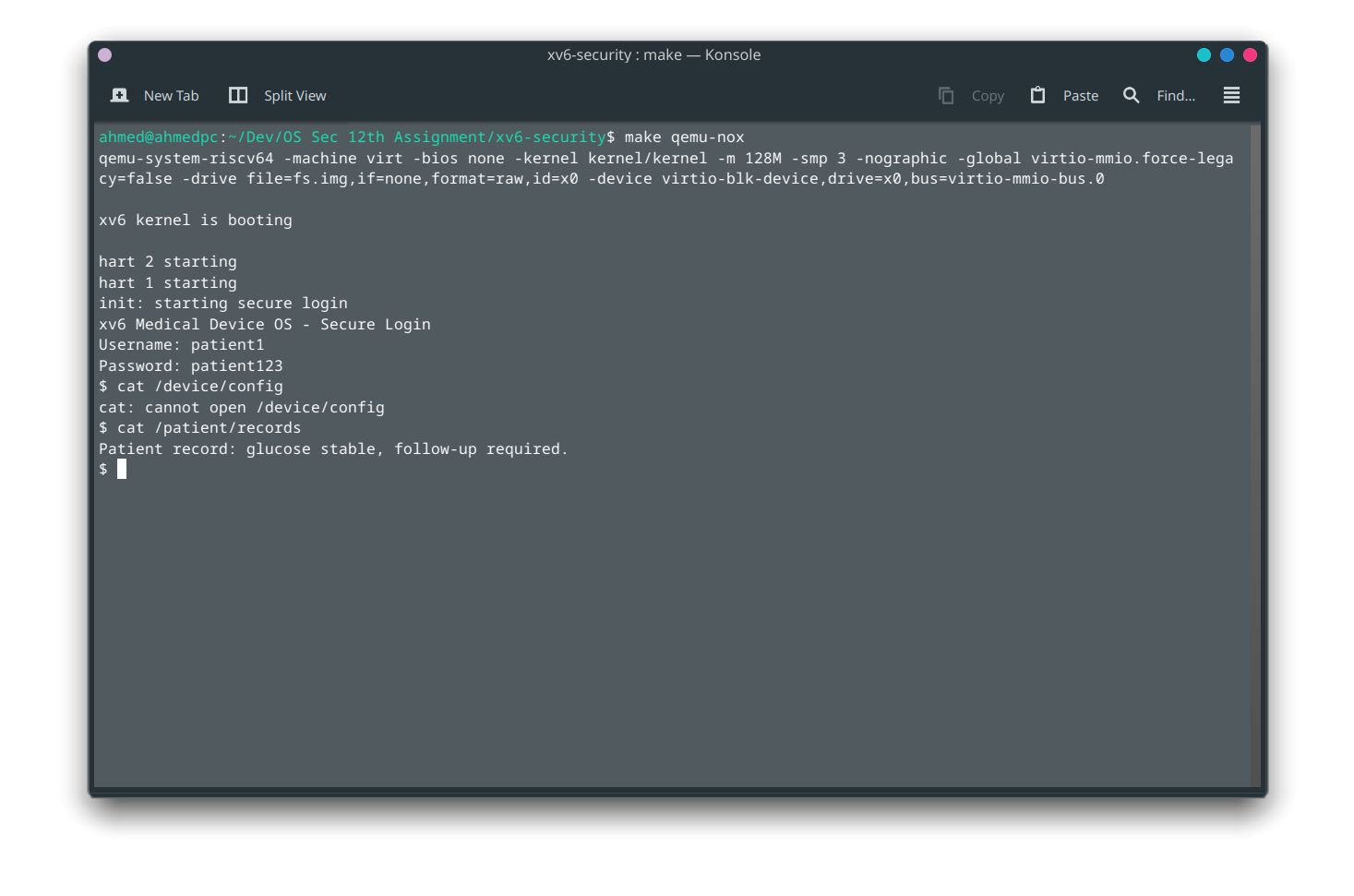
| Test | What it checks |
|---|---|
| T07 | Patient cannot open /device/config (EACCES) |
| T08 | Patient can read /patient/records |
| T09 | Patient cannot write /patient/records (EACCES) |
| T10 | Clinician can write /dosage/insulin.log |
| T11 | Clinician cannot read /device/config (EACCES) |
| T12 | Admin can open all protected files |
Known Implementation Detail: DIRSIZ
The filename compliance_test is 16 characters. The original xv6 DIRSIZ is 14. We increased it to 16:
/* kernel/fs.h */
#define DIRSIZ 16
This required updating mkfs.c to pad directory entries to the new size so that ls and directory reads remain aligned to struct dirent.